
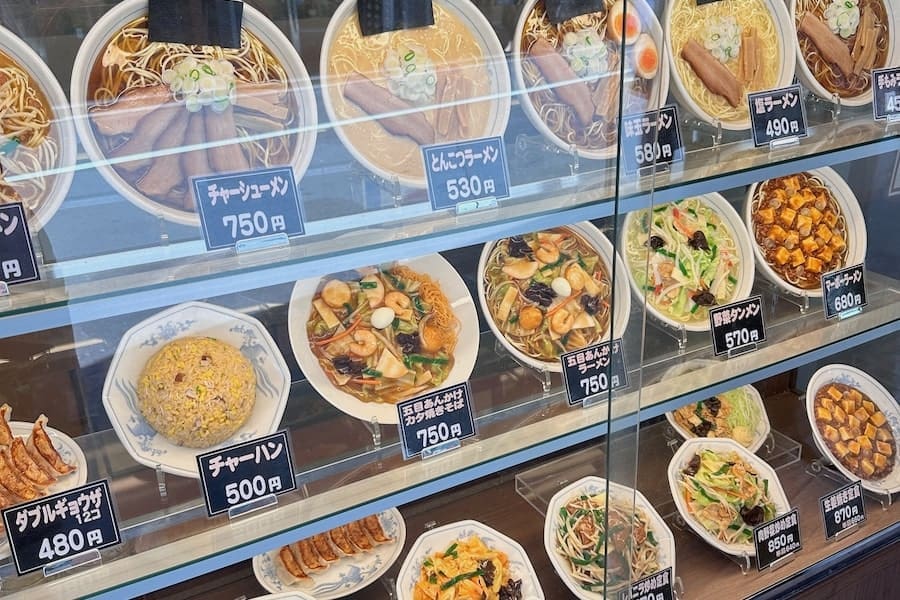
There are so many things to eat in Japan that even a long trip can leave you with a list of foods you haven’t tried yet. And that’s before you start comparing regional versions of ramen or working your way through the sweets in a department-store food hall.
I’ve put together a checklist of 28 Japanese dishes and sweets, grouped by type, from noodles and rice bowls to grilled dishes, hot pots, and snacks. Each entry includes a description and the Japanese name, with restaurant suggestions in Tokyo along the way. You can also download the PDF checklist at the end of the article to tick off the foods you’ve tried.
Some links on YavaJapan are affiliate links. If you book or buy through them, I may earn a small commission at no extra cost to you. It helps support the site, and I only link to places, stays, and experiences I genuinely think are worth recommending.
Noodles
Ramen (ラーメン)
Ramen is a bowl of wheat noodles in broth, usually with toppings such as sliced pork, spring onions, and egg. The broth changes the meal considerably. Try tonkotsu (pork bone broth) for something rich, shoyu (soy sauce seasoning) for a soy-flavored bowl, or miso ramen for the flavor of fermented soybean paste.
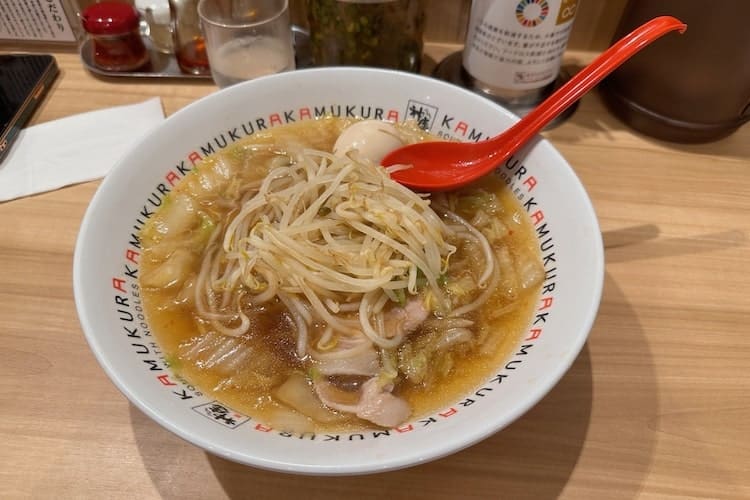
Ichiran, written 一蘭, is an easy chain to look for if you want tonkotsu ramen. You choose preferences such as noodle firmness on an order sheet. But I also recommend searching near where you’re spending the day, especially if the nearby Ichiran has a long queue.
If ramen is a particular interest, Ramen Database has Japanese-language reviews and rankings. For something different on another day, look for tsukemen (つけ麺), where you dip the noodles into a separate bowl of concentrated broth.
Udon (うどん)
Udon are thick wheat noodles with a soft, chewy texture. You can have them in hot broth or served cold, with toppings ranging from spring onions to beef or tempura. They’re a good lunch when you want noodles with a very different texture from ramen.
For a first order, try a plain bowl with tempura on the side. At a self-service udon shop, you can often choose your noodle dish first, then add individual pieces of tempura as you move along the counter.
Soba (そば)
Soba are thinner noodles made with buckwheat flour, often mixed with wheat flour. They have a more pronounced grain flavor than udon. On a hot day, I suggest trying them cold with a separate dipping sauce. Dip a mouthful at a time, then add a little wasabi or spring onion if you want.
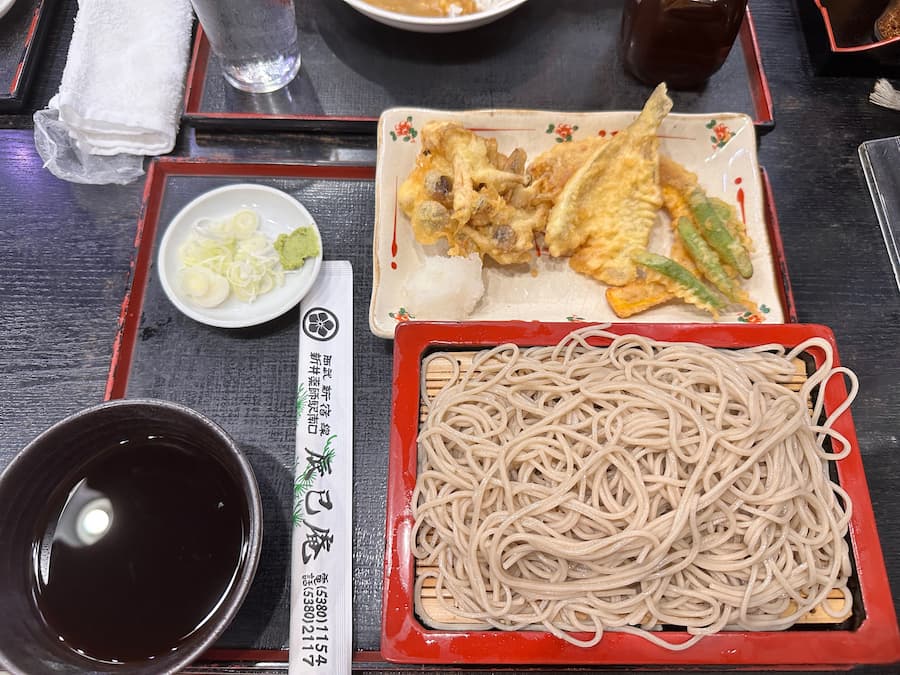
You can also order soba in hot broth. Tempura is a common accompaniment, so a soba lunch can let you try both. In Tokyo, Kanda Matsuya, near Akihabara, is a restaurant I recommend considering.
Yakisoba (焼きそば)
Despite the name, yakisoba uses wheat noodles rather than buckwheat soba. The noodles are stir-fried with ingredients such as cabbage and pork, then seasoned with a savory sauce. They’re a common food-stall meal at summer festivals.
If you’re at a festival and want something more filling than a small snack, get a portion freshly cooked on the griddle. At other times, look for yakisoba at restaurants serving okonomiyaki, the savory cabbage pancake described below.
Rice Dishes and Fried Foods for Lunch
A teishoku (set meal) usually brings a main dish with rice, soup, and small sides. It’s useful to recognize that word on a menu: a plate of fried pork and a complete lunch may appear as separate orders. Donburi means a rice bowl with toppings, including the chicken-and-egg and pork-cutlet bowls below.
Japanese Curry Rice (カレーライス)
Japanese curry has a thick sauce served with rice, often with meat or vegetables. It’s usually milder and sweeter than many Indian curries, although restaurant versions can be very spicy if you choose a high heat level.
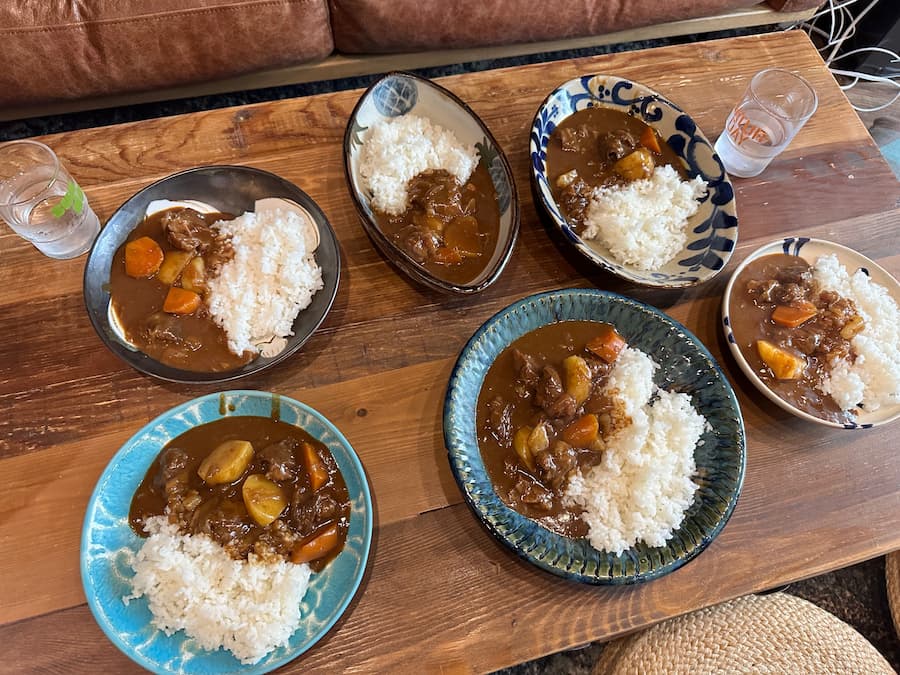
I’ve always loved the curry at CoCo Ichibanya, often called CoCo Ichi. It’s an affordable chain where you can choose the toppings, rice portion, and spice level. A pork cutlet on top makes a filling lunch, while vegetables or an egg give you other ways to order it. Start with the standard spice level if you’re unsure how hot you want it.
Omurice (オムライス)
Omurice is seasoned fried rice wrapped in or topped with an omelet. The rice is often flavored with ketchup, and the finished dish may have ketchup or a richer demi-glace sauce on top. Some restaurants serve a neatly folded omelet, while others make a soft one that opens over the rice.
It’s simple, familiar food, and surprisingly satisfying. Look for it in cafes and yoshoku restaurants, which serve Japanese versions of Western-style dishes. Choose the sauce and omelet style you want from the menu photos.
Oyakodon (親子丼)
Oyakodon is chicken and onion simmered in a sweet soy-based broth, finished with egg, and served over rice. The egg is often softly set, so the topping mixes into the rice as you eat.
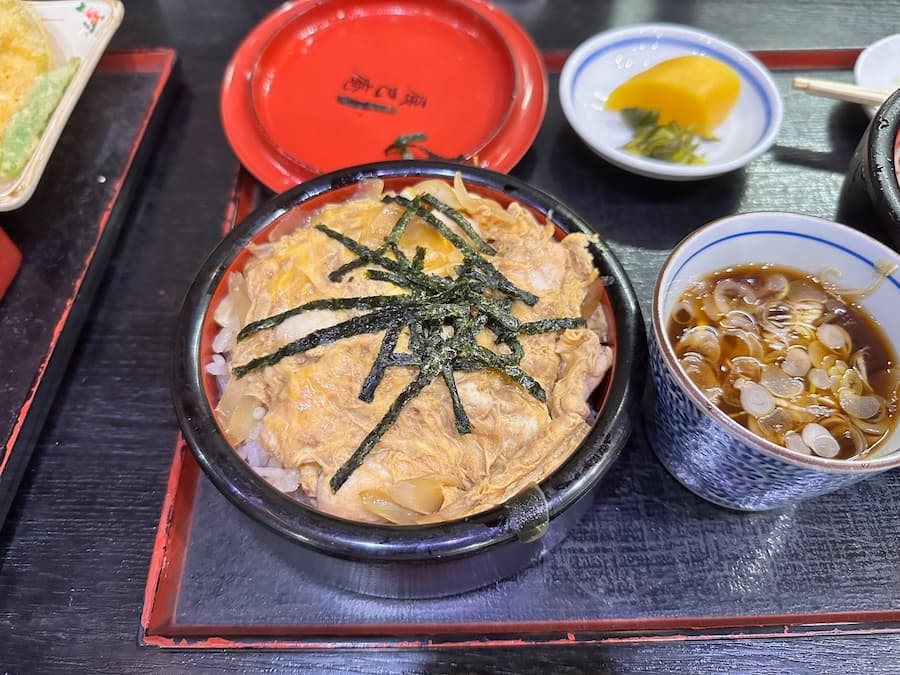
It’s one of my favorite rice dishes. The name means parent-and-child bowl, referring to the chicken and egg, which is a slightly unfortunate thing to think about over lunch. You’ll find it at chicken specialists and some soba restaurants, as well as casual chains.
Tonkatsu (とんかつ)
Tonkatsu is a pork cutlet coated in breadcrumbs and deep-fried, usually served with finely shredded cabbage and a thick sauce. Order it as a set meal if you want rice and soup alongside it.
The two cuts you’ll commonly see are rosu (loin), which has more fat, and hire (fillet), which is leaner. I recommend Tonkatsu Hasegawa in Ryogoku, Tokyo’s sumo district, if you’re looking for a specialist restaurant.
Katsudon (カツ丼)
Katsudon puts a pork cutlet on a bowl of rice. A common version simmers the cutlet with onion, egg, and a sweet soy-based sauce, making the coating softer than a separately served tonkatsu.
If you want a crisp cutlet, choose tonkatsu. If you want the pork, egg, sauce, and rice together in one bowl, try katsudon. Regional versions can use sauce without egg, so menu photos are helpful here too.
Tempura (天ぷら)
Tempura is seafood or vegetables coated in a light batter and fried. Shrimp is a familiar starting point, but I also recommend trying a few vegetables, such as eggplant, pumpkin, or mushrooms. Tempura is a favorite of mine, partly because there are so many different ingredients to try.
For lunch, order a tendon (天丼), a bowl of rice topped with tempura and sauce. At a specialist counter, you may instead receive pieces as the chef fries them, with salt or dipping sauce on the side.
Tenoto (天音) is one restaurant I recommend in Ningyocho, the Tokyo neighborhood where I lived for 5 years.
Sushi and Seafood
Sushi (寿司)
Sushi combines seasoned rice with fish, seafood, or other toppings and fillings. Raw fish is only part of the choice: cooked shrimp, eel, egg, and vegetable rolls can also appear on the menu.
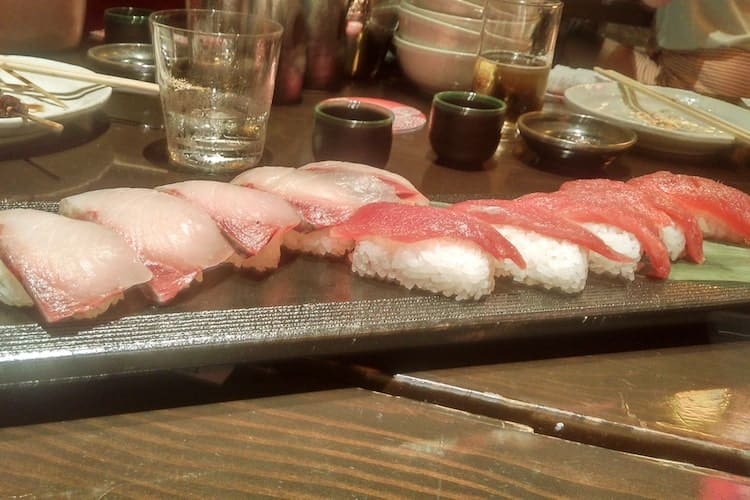
For an affordable meal where you can try several kinds, I recommend Sushiro, written スシロー. Order a few plates, see what you enjoy, and add more. It gives you more freedom to choose individual pieces than a fixed course does.
I went to Jiro Sushi, and although I respect the skill involved, I don’t recommend stretching your budget for it unless sushi is a serious interest. You can eat excellent sushi for much less. For me, the difference in taste wasn’t large enough to make that kind of spending necessary for a good sushi meal in Japan.
Sashimi (刺身)
Sashimi is sliced raw fish or seafood served without sushi rice. It lets you try the fish on its own, with soy sauce and wasabi served alongside it. An assorted plate is useful if you want to compare a few types.
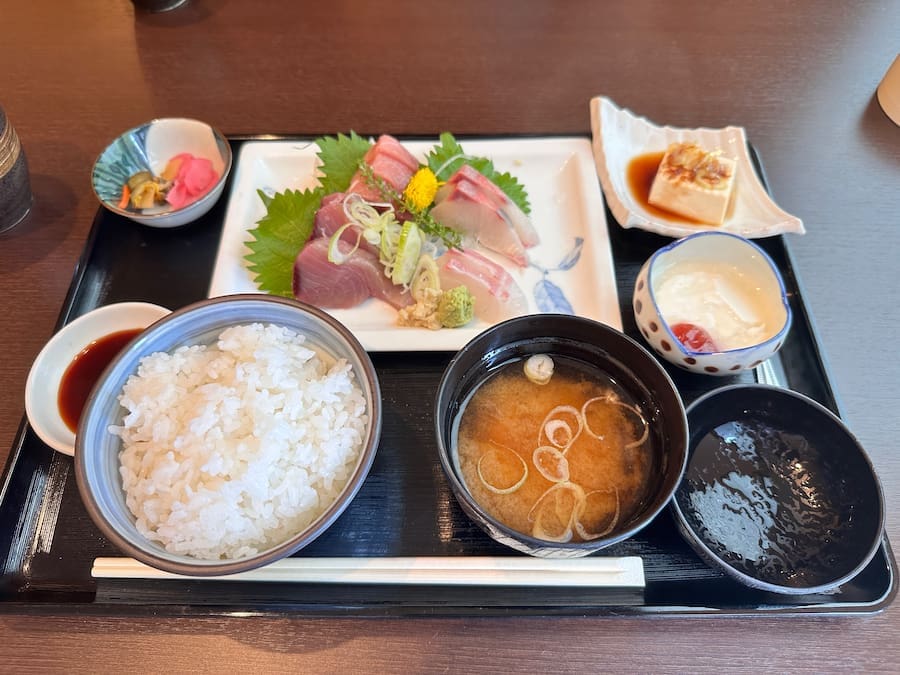
You can order sashimi to share at an izakaya (a casual place serving drinks and small dishes), or have it as a set meal with a separate bowl of rice. If you’ve already planned a Japanese dinner at your accommodation, check the menu: sashimi may be part of that meal.
Unagi (うなぎ)
Unagi means freshwater eel. A common way to eat it is grilled with a sweet soy-based glaze and served over rice. Look for unadon (うな丼), served in a bowl, or unaju (うな重), served in a rectangular box.
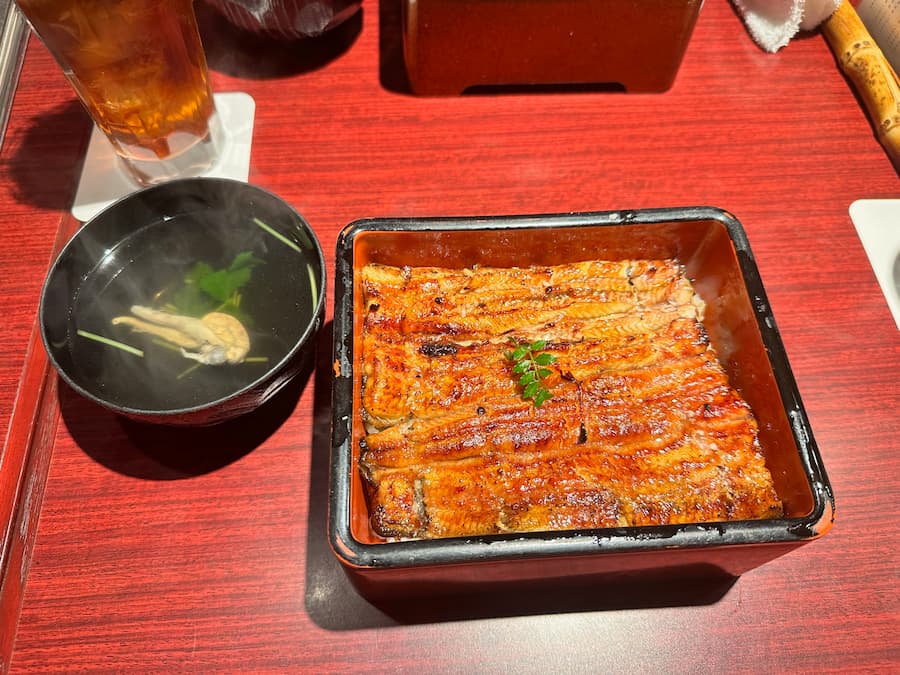
This usually costs more than a basic curry or noodle lunch, so check the menu before sitting down. Izuei Honten in Ueno is one Tokyo option I recommend, with an English menu showing the eel bowls, boxes, and full courses.
Grilled Dishes for Dinner
Yakitori (焼き鳥)
Yakitori (grilled chicken skewers) is my favorite food on this list. You order chicken skewers made from different cuts, so a meal can include thigh, breast, skin, liver, and meatballs. It’s especially good for an evening with friends, ordering a few skewers at a time with a beer.
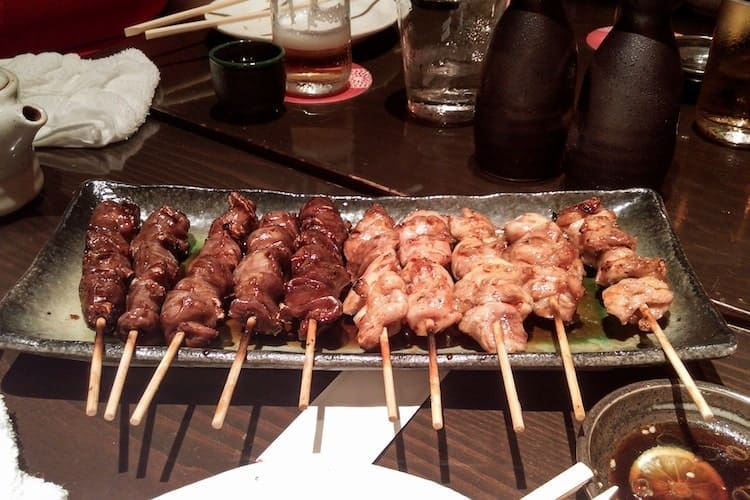
If you’re new to it, start with thigh and tsukune (chicken meatballs). You’ll often have a choice of salt or tare, a sweet soy-based sauce. Heart, liver, or cartilage are options if you want to try other cuts.
For a more expensive counter dinner, Yakitori Omino near Tokyo Skytree serves a chef-selected course. Reserve in advance for this one, and check the booking conditions if you’re traveling with children or have dietary restrictions. For a casual evening, search 焼き鳥 near your hotel and choose somewhere serving individual skewers.
Yakiniku (焼肉)
Yakiniku is grilled meat, often cooked by you on a grill at the table. You order different cuts and cook them a little at a time, making it a good dinner to share. Beef is common, with pork and other meats available depending on the restaurant.
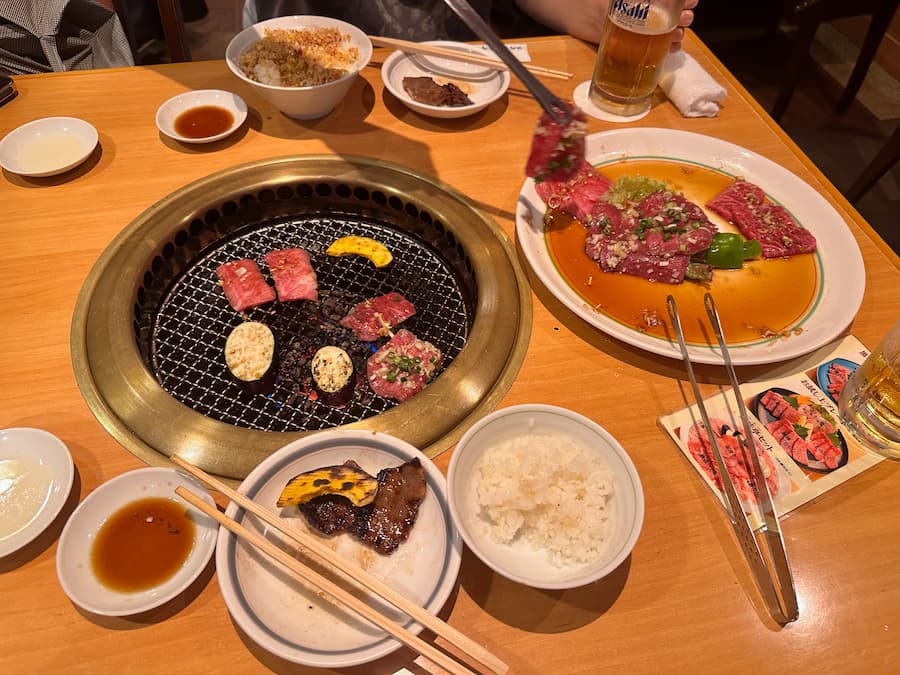
An assorted plate can be a good starting point if you’re unsure which cuts to choose. This is also one way to try wagyu, Japanese beef from specific cattle breeds, without ordering a large steak. Check which beef is included, as yakiniku menus cover a wide range of prices. Smoke and cooking smells can cling to your clothes, so save your favorite jacket for another evening.
Okonomiyaki (お好み焼き)
Okonomiyaki is a savory pancake made with batter, cabbage, and ingredients such as pork or seafood, cooked on a flat griddle. It’s usually finished with a thick sauce, and often mayonnaise, seaweed, and dried fish flakes.
Try it in Osaka or Hiroshima if either is on your route. Osaka-style versions generally mix the ingredients into the batter, while Hiroshima-style versions build them in layers and commonly include noodles. Both make a filling meal.
Some restaurants cook it for you, and others have a griddle at your table. In Tokyo, Sakura-tei in Harajuku is a place I recommend. Its menu also includes yakisoba, so you can share different dishes if you’re eating with someone.
Hot Pots and Longer Dinners
Shabu-Shabu (しゃぶしゃぶ)
Shabu-shabu is a hot pot meal with thinly sliced meat and vegetables that you cook at the table. You swish the meat through the hot broth, then dip it in sauces, commonly sesame sauce or a citrus-based one.
Choose this if you want to cook and eat gradually over dinner. Zakuro Ginza is one Tokyo restaurant I recommend considering. Check the meat and course options before booking, since the choice of beef can change the price considerably.
Sukiyaki (すき焼き)
Sukiyaki also uses thin slices of beef with vegetables and tofu, but the sweet soy-based cooking sauce gives it a stronger flavor than shabu-shabu. The cooked ingredients are traditionally dipped in beaten raw egg before eating. You can leave out that dipping step if you prefer.
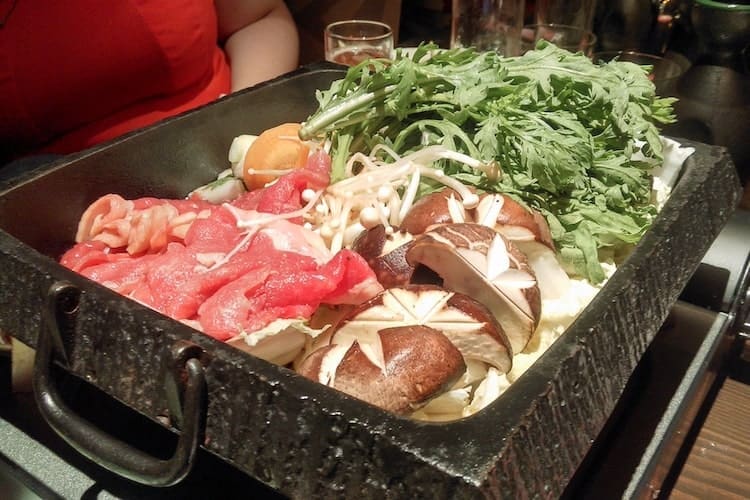
If you want to choose between the two, go for sukiyaki for the sweeter sauce, or shabu-shabu for the lighter broth and separate dipping sauces. Shabuzen Roppongi serves both in Tokyo.
Oden (おでん)
Oden is an assortment of ingredients simmered in a savory broth: daikon radish, boiled eggs, fish cakes, and konnyaku, a firm jelly made from konjac. It’s particularly good to look for in colder weather, when a few hot pieces make a welcome break from walking outside.
It has always reminded me a little of French pot-au-feu, with different ingredients but a similar appeal of food cooked together in broth. At an oden counter, you can choose individual pieces. I suggest starting with radish, egg, and a fish cake to try a few different textures.
Chanko Nabe (ちゃんこ鍋)
Chanko nabe is the hot pot associated with sumo wrestlers. There isn’t one fixed recipe: the pot can contain meat or seafood, vegetables, tofu, and different broths. It’s a substantial shared meal, with ingredients cooked together.
If you’re spending time in Ryogoku, Tokyo’s sumo district, I recommend trying it there. Search ちゃんこ鍋 near Ryogoku Station and check the restaurant’s portion requirements if you’re dining alone. It can also fit into a day when you’re watching a sumo tournament in Tokyo.
Kaiseki (懐石料理・会席料理)
Kaiseki is a multi-course Japanese meal, with small dishes served in a planned sequence and ingredients that change with the season. Depending on the menu, you might have sashimi, grilled fish, simmered vegetables, soup, and rice. Allow time to sit down and enjoy the whole meal.
If you’re staying in a ryokan (traditional Japanese inn), check whether dinner is included. The food is a big part of the experience, and a kaiseki-style dinner there may already give you the meal you’re hoping to try. My guide to choosing a Kyoto ryokan explains more about the stays and meals.
For a private meal combined with a cultural experience, I recommend browsing Wabunka. It’s a website for private cultural experiences and stays in Japan, working with chefs, artisans, and other hosts. Its experiences are for your own group, with interpreter support when needed, giving you time to talk with the people hosting you. These cost more than an ordinary restaurant meal and suit a trip where that personal interaction is part of what you’re looking forward to.
For other ways to combine food with an activity, see my Japanese cultural experiences guide.
Snacks and Small Dishes
Onigiri (おにぎり)
Onigiri are rice balls, often triangular, with fillings such as salmon, tuna mayonnaise, or pickled plum. Many are wrapped in nori seaweed. They’re an easy breakfast or snack from a convenience store, especially when you want something small before heading out.
Freshly made onigiri from a specialist shop are worth trying too. Onigiri Asakusa Yadoroku is one Tokyo suggestion. Choose a couple of fillings and compare them, rather than ordering several of the same kind.
Takoyaki (たこ焼き)
Takoyaki are round balls of batter containing pieces of octopus, cooked in a special molded pan. They’re usually topped with sauce, dried bonito fish flakes, and sometimes mayonnaise. The outside holds its shape while the center stays soft.
I recommend getting them freshly cooked from a specialist shop or stall, especially in Osaka, where they originated. A small portion is easy to share between meals. Let them cool a little before taking a full bite: the center can be much hotter than the outside suggests.
Gyoza (餃子)
Gyoza are dumplings commonly filled with pork, cabbage, and seasonings. The familiar pan-fried version has a crisp bottom and a soft upper wrapper, but you can also find boiled and steamed versions.
Order a plate alongside ramen, share some at an izakaya, or make them a meal at a gyoza specialist with rice and soup. They’re a convenient way to try another food without planning a separate restaurant visit just for it.
Karaage (唐揚げ)
Karaage usually means bite-sized pieces of Japanese fried chicken, often seasoned with soy sauce, ginger, or garlic before frying. You get more crust around each piece than you would with a whole fried chicken breast.
It’s sold in supermarkets and takeaway shops, and appears on many izakaya menus. Try a small portion as a snack or a plate to share with drinks. A karaage set meal with rice and soup is also a full lunch if you’re particularly hungry.
Sweets to Try Between Meals
Taiyaki (たい焼き)
Taiyaki is a fish-shaped cake cooked in a mold, usually with sweet red bean paste inside. The fish shape doesn’t mean it contains fish. Custard is another filling you may find.
Try one freshly cooked from a taiyaki shop, while the outside is still crisp. It’s a good sweet to share if you’ve just had lunch but want to taste something else.
Daifuku (大福)
Daifuku is a filled sweet made with mochi, a chewy rice dough. The filling is often sweet red bean paste, and the soft outer layer is quite different from a cake or pastry. Strawberry daifuku adds a strawberry inside, while other versions use different fruits or fillings.
Look in Japanese sweet shops or department-store food halls. I suggest buying one or two to eat that day, following the shop’s storage advice, particularly for versions containing fresh fruit or cream.
Dango (団子)
Dango are chewy rice-flour dumplings, often served on a skewer. For something sweet and savory together, try mitarashi dango (みたらし団子), coated in a sweet soy-based glaze.
You’ll find them at Japanese sweet shops and stalls. They make a good choice if you’d prefer to try something without a red bean filling. Tea is a nice accompaniment, especially if you want to sit down for a break.
Finding These Foods During Your Trip
Search for the dish near where you already are. Copy its Japanese name into Google Maps, then look at the menu photos, opening hours, and location. The Tokyo restaurants above give you some starting points, but most of these foods are available much more widely.
For casual noodles, rice bowls, and snacks, I usually suggest choosing somewhere during the day. Reserve in advance for a particular counter restaurant, a private experience, or a dinner you’re especially looking forward to. My Japan booking guide explains which bookings benefit from earlier planning.
If you’re vegetarian or vegan, check the broth and sauces as well as the main ingredients. Dashi, a Japanese cooking stock, often contains fish, including in dishes that look vegetable-based. The vegetarian and vegan guide to Japan has more on finding suitable meals. For allergies, confirm ingredients directly with the restaurant.
Japan Food Checklist
Download the checklist to keep on your phone or print for your trip.
Open the downloaded PDF in a PDF app such as Adobe Acrobat Reader to tick the boxes and save your progress.
Comments are closed.