Tag

Chopsticks

Browsing

If you are looking for the best chopstick-making workshop in Tokyo, this is probably it.

It is also clearly not the right pick for everyone.

Mogami Kogei costs much more than the simpler chopstick classes around Tokyo. The question is whether you want a more private, more personal experience in a real craftsman’s workshop, or if a shorter and cheaper class would suit you just fine.

I did it myself through Wabunka, and I loved it.

Some links on YavaJapan are affiliate links. If you book or buy through them, I may earn a small commission at no extra cost to you. It helps support the site, and I only link to places, stays, and experiences I genuinely think are worth recommending.

Quick Verdict

Yes, I think Mogami Kogei is worth it if you want the best version of this kind of activity in Tokyo.

I would not recommend it to every traveler. If you just want a fun and affordable class where you make a pair of chopsticks and move on with your day, there are cheaper options that make more sense.

But if you want something private, more personal, and much less touristy, this is the one I would look at first.

If you want to compare it with the cheaper alternatives first, I have a separate roundup on the best chopstick-making workshops in Japan.

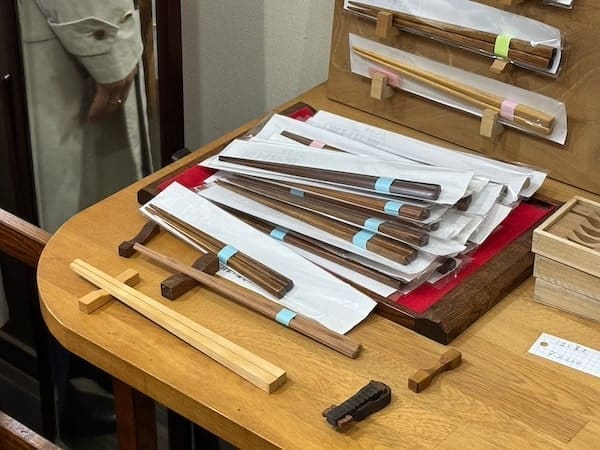
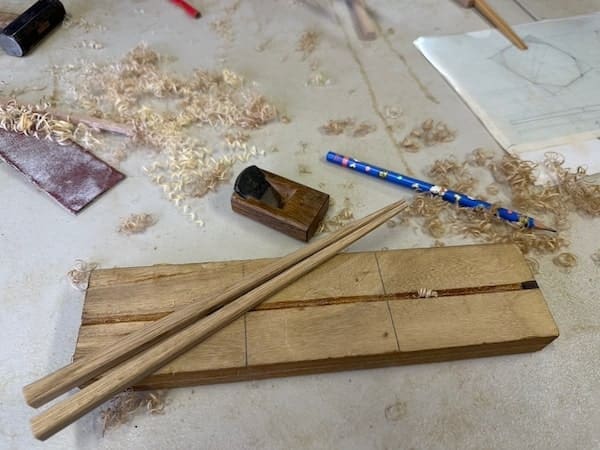
Chopstick on a table in Mogami Kogei workshop in Kuramae, Tokyo
Hand-made chopsticks at Mogami Kogei workshop

What This Experience Actually Is

This is a private chopstick-making experience in Kuramae with Mogami-san, a traditional woodworker who works in the Edo sashimono world.

I was invited by Wabunka, which I recommend often on YavaJapan for this kind of experience. Wabunka focuses on private cultural experiences and stays in Japan for international travelers, usually built around respected hosts, meaningful settings, and a much more personal format than the usual tourist class. Here, that means private time in Mogami-san’s real workshop, plus interpreter support when it helps the conversation go deeper.

You are not just booking a slot in a generic class. You are booking time in a real workshop, with a real craftsman, in a format that feels much more personal than the usual tourist-facing version of this kind of activity.

Why I Joined This Experience

I have been living in Japan since 2019 and working in the Japan travel industry for just as long, so I have seen a lot of workshops and activities that sound great online and feel forgettable in real life.

This one did not have that problem.

What interested me was not just the chopsticks. It was the chance to spend time in a proper workshop, talk with Mogami-san, and see whether the premium angle actually translated into a better experience on the ground.

It did.

The Short Version of How It Felt

The best way I can describe it is this: it felt like visiting someone’s working world, not dropping into a tourist product.

That difference is exactly why I would pay more for something like this.

Here is a short video I made about this experience:

@yavajapan

I think i just found the ultimate souvenir to bring back from Japan😳 Mogami-san was such a kind soul, honestly the experience is as much talking and learning from him as it is about making chopsticks 😌 Mogami-san’s English is not bad but limited so we had an (amazing) guide with us translating and helping us discuss with the master ✌️ Honestly it was the best workshop I’ve done so far in Japan, really impressed👌 If you want to do it when you’re in Tokyo you need to book ahead inline, the website name is Wabunka #japantravel #tokyotravel #handwork #woodworking #chopsticks #japanthingstodo

♬ original sound – yavajapan

Visiting the Workshop

My group met our guide first, then headed into Mogami-san’s workshop in Kuramae.

The space immediately felt right. Small, lived-in, full of tools, full of wood, and clearly not designed from scratch to look polished for visitors.

Mogami-san showed us the storefront and some of his creations before taking us further in. He works with Edo sashimono, a traditional Japanese woodworking technique built around joinery rather than nails, and even if the chopsticks themselves are simpler than a full sashimono piece, that background gives the workshop much more character.

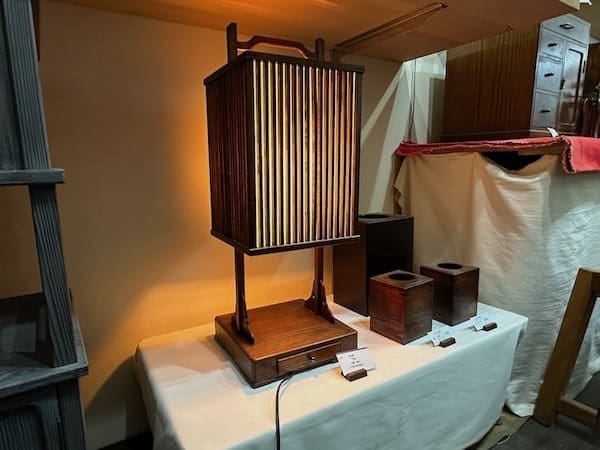
Lamp made with edo sashimono technique at Mogami Kogei workshop in Kuramae, Tokyo
This lamp was made using Edo Sashimono technique

One of the reasons the visit stayed with me is that it never felt rushed. It felt like we were being welcomed into a real place of work.

Making the Chopsticks

Before we started, Mogami-san offered traditional workwear, which of course I accepted immediately because I looked far more competent in it than I actually was.

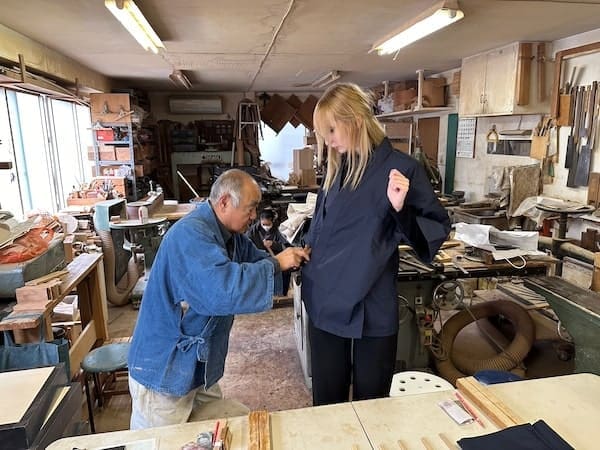
Mogami Kogei workshop in Kuramae, Tokyo
We all got to wear a traditional workwear outfit

The workshop itself is beginner-friendly, but it is not so simple that your hands can go on autopilot.

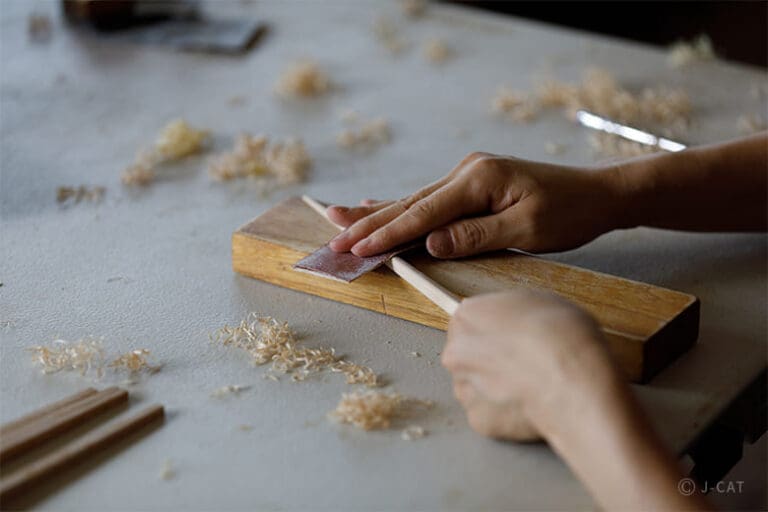
You choose your wood first, then shape the chopsticks by cutting down the corners step by step, then sand them smooth, then finish them.

Mogami-san and the interpreter guided us through it clearly, which was lucky for me because I was nowhere near as naturally gifted as I had imagined in my head.

I really thought I would breeze through it.

Absolutely not.

At several points, I managed to make mistakes that would have turned my chopsticks into something much less elegant if Mogami-san had not stepped in and quietly rescued the situation.

So if you are reading this and worrying that you are too clumsy for it, do not.

You will be fine.

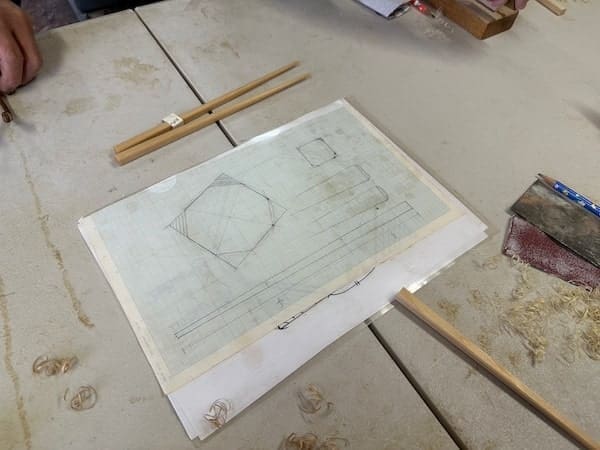
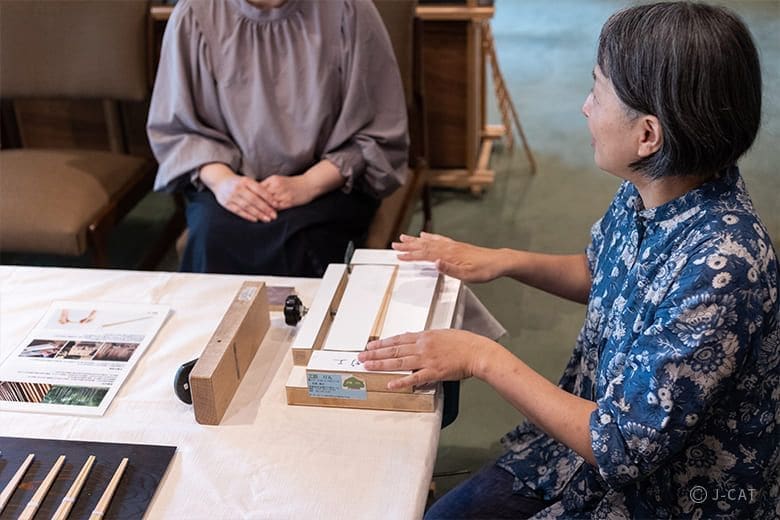
Chopstick making manual Mogami Kogei workshop in Kuramae, Tokyo
Visual explanations of the chopstick-making process

The Best Part Was Not Just the Craft

The biggest difference between this and a cheaper class is not that the chopsticks magically become ten times better.

It is that the whole thing feels more human.

While we worked, we were able to talk with Mogami-san about his craft, his family, his workshop, and the industry itself. That part is much harder to get in a bigger, more standardized class.

The interpreter helps for a very simple reason: it lets the exchange breathe. You are not stuck smiling politely through a language wall. You can actually ask things, follow up, and learn more.

The Finishing Touch

The last stage was the lacquer, which is where everything suddenly looked much more impressive than it had a few minutes earlier.

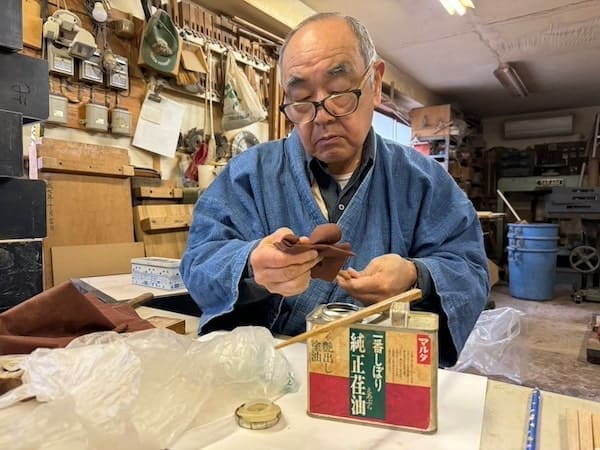
Mogami-san, owner of Mogami Kogei workshop in Kuramae, Tokyo
Mogami-san applying lacquer to his chopsticks

By the end, I was holding a pair of chopsticks that looked far better than they had any right to given my own contribution to the process.

That is still one of my favorite things about the experience. It is hands-on, but you are not left alone to ruin the final result.

What Makes Mogami Kogei Different

Here is the real value proposition as I see it:

  • Private format
  • Interpreter support
  • A real workshop setting
  • A host who genuinely feels worth meeting
  • A more personal overall experience

It is a different kind of experience from the quick, inexpensive classes around Tokyo. If you mainly want a fun activity and a handmade souvenir, those can work perfectly well. If you want the strongest premium version of this idea in Tokyo, this is the one I would recommend first.

Who This Is For

I would recommend this most to:

  • travelers who want a special craft experience, not just a quick activity
  • couples or small groups who value privacy
  • people who care about traditional craftsmanship
  • travelers doing a milestone trip, honeymoon, or one big splurge experience
  • families with older kids or teenagers who enjoy hands-on activities

Who Should Skip It

I would skip this if:

  • you are mainly trying to keep costs down
  • you just want a quick class and do not care much who is teaching it
  • you would rather do several cheaper activities than spend more on one
  • you are already very experienced in woodworking and mainly want technical challenge

If you are already highly skilled with your hands, you may not find the chopstick-making itself difficult enough to be the main attraction. In that case, the value is much more about the workshop visit and the human side of the experience.

Is It Worth the Price?

For me, yes.

Not because chopsticks are inherently worth a premium price. They are not.

It is worth it because this is one of those rare cases where spending more changes the feel of the experience in a real way.

You are paying for:

  • a private setup
  • better host access
  • interpretation
  • a stronger sense of place
  • an experience that feels very different from a standard class

If budget is not your main concern and you want the best overall chopstick-making experience in Tokyo, I think the price makes sense.

How to Book

You can book the experience directly on Wabunka.

If you are booking during a busy travel season, I would not leave it until the last minute.

Bottom Line

I have done enough activities in Japan at this point to know when something feels genuinely special and when something is just well packaged.

This one felt genuinely special.

If I had to recommend just one premium chopstick-making experience in Tokyo, this would be it.

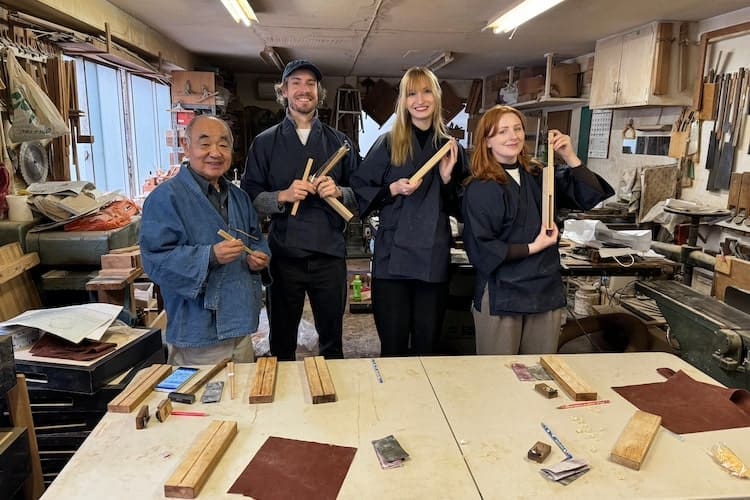
Chopstick-making experience in Mogami Kogei workshop in Kuramae, Tokyo
Posing proudly with our finished chopsticks

You can make your own chopsticks in both Tokyo and Kyoto, with beginner workshops that usually take around 1 to 2 hours. I tried it at Mogami Kogei in Tokyo and loved the experience. Making a pair to take home was satisfying, and the time talking with Mogami-san in his workshop made the visit even more memorable.

If you’d enjoy meeting an artisan and learning about their work, I strongly recommend a private session. Mogami Kogei is my favorite in Tokyo, while Takano Chikko near Kyoto combines bamboo chopstick making with tea and sweets. Both cost considerably more than a group class, though. For a shorter, more affordable activity, I recommend the Kuramae workshop in Tokyo or a class near the places you’re already visiting, such as the Gion workshop in Kyoto.

Some links on YavaJapan are affiliate links. If you book or buy through them, I may earn a small commission at no extra cost to you. It helps support the site, and I only link to places, stays, and experiences I genuinely think are worth recommending.

At a Glance

  • Private workshop in Tokyo: Mogami Kogei, with an interpreter and a wooden box for your finished chopsticks
  • Private bamboo experience near Kyoto: Takano Chikko, in Nagaokakyo, a separate city southwest of Kyoto
  • A class near Kyoto’s sightseeing streets: The Gion workshop, near Yasaka Pagoda
  • Affordable class in eastern Tokyo: The Kuramae workshop, with English-speaking staff and about 1 hour of crafting
  • Already visiting Nara: The Nara workshop, where you make chopsticks from Yoshino cedar
@yavajapan

I think i just found the ultimate souvenir to bring back from Japan😳 Mogami-san was such a kind soul, honestly the experience is as much talking and learning from him as it is about making chopsticks 😌 Mogami-san’s English is not bad but limited so we had an (amazing) guide with us translating and helping us discuss with the master ✌️ Honestly it was the best workshop I’ve done so far in Japan, really impressed👌 If you want to do it when you’re in Tokyo you need to book ahead inline, the website name is Wabunka #japantravel #tokyotravel #handwork #woodworking #chopsticks #japanthingstodo

♬ original sound – yavajapan

Compare Chopstick Workshops

Tokyo and Nearby

WorkshopAreaCostWhy Choose It?Booking
Mogami KogeiKuramae, TokyoPremiumPrivate time with a woodworker and an interpreterWabunka
Kuramae Artisan WorkshopMisuji, near KuramaeBudgetA short class with English-speaking staffViator, GetYourGuide, Klook
Shinjuku Chopsticks Making ClassNishi-Shinjuku, TokyoBudgetA class near Shinjuku’s hotels and shopsViator, GetYourGuide, Klook
Ginza WorkshopGinza, TokyoBudgetA class during a day around GinzaGetYourGuide
Karaki MokkoKawagoe, SaitamaBudgetA workshop during an existing Kawagoe day tripJalan

Kyoto and Nearby

WorkshopAreaCostWhy Choose It?Booking
Takano ChikkoNagaokakyo, Kyoto PrefecturePremiumPrivate bamboo workshop with an interpreter, matcha, and sweetsWabunka
Nara WorkshopNaraBudgetYoshino cedar chopsticks with artisan guidanceGetYourGuide
Yokoyama Bamboo StoreKamigyo, KyotoMid-rangeBamboo carving at an established bamboo businessActivity Japan
Gion WorkshopNear Yasaka Pagoda, KyotoBudgetA class during a day in eastern KyotoViator, GetYourGuide
Marumasu-NishimurayaNakagyo, KyotoBudgetChopstick making plus a dyed fabric caseWAmazing
Kyomachiya Workshop WarakuHigashiyama, KyotoBudgetBamboo chopsticks in a traditional townhouseActivity Japan

What Happens in a Chopstick Workshop?

In many of these workshops, you’ll choose your wood, shave it into shape, smooth it with sandpaper, and apply an oil finish. You’ll often use a hand plane, a tool that removes thin layers of wood, with a support holding the wood in place while you work. Bamboo workshops may use a small knife instead.

The instructor helps you through the process, so you can join as a beginner. I wasn’t especially good at it myself, but I still left Mogami Kogei with a pair I was happy to take home. If you’d prefer a larger project, making your own knife is another possibility, though the work and time involved vary much more between knife workshops.

Chopstick Workshops in Tokyo

Mogami Kogei: My Favorite Private Workshop

Mogami Kogei is the workshop I recommend if you’re happy to spend more for a private visit with a woodworker. It’s in Kuramae, in eastern Tokyo, and you’ll be making your chopsticks in the artisan’s working studio.

Mogami-san was so kind during my visit. We had an interpreter with us, which meant we could talk with him and learn about his work while making the chopsticks. That conversation was a big part of why I enjoyed it so much, and I was proud of our finished pairs despite my very average woodworking skills.

Chopstick-making experience in Mogami Kogei workshop in Kuramae, Tokyo
Posing proudly with our finished chopsticks

The session takes about 1 hour 30 minutes. Your finished chopsticks come with a handmade paulownia wood box to take them home in. Your instructor may be Yutaka Mogami or his son Ryo, depending on the session.

You book through Wabunka, a website offering private cultural experiences and stays in Japan. They work directly with artisans and other hosts to arrange visits for international travelers, with no mixed groups. Here, your party has the workshop to itself and an interpreter to help you talk with your host. I think that personal time is worth the higher price if you’re curious about the person and the craft as well as the chopsticks you’ll make.

You can read more about my visit in my full Mogami Kogei review.

Kuramae Artisan Workshop: My Budget Recommendation

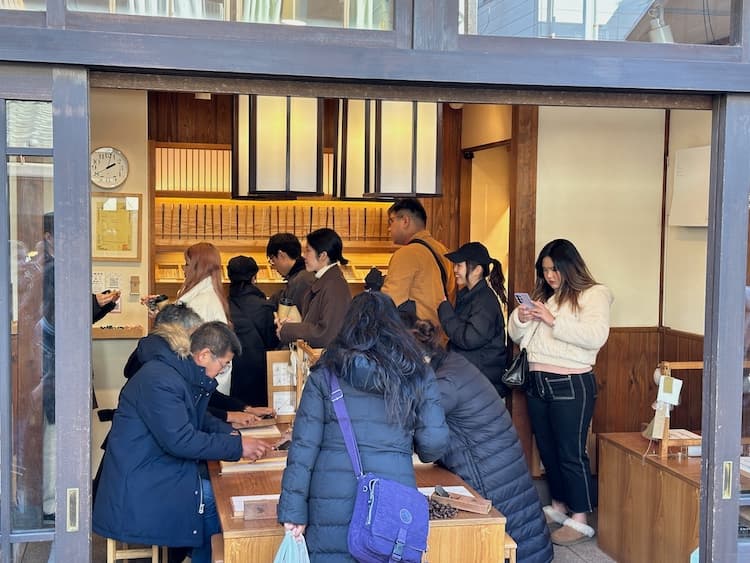
For an affordable workshop in eastern Tokyo, I recommend the Kuramae class. You spend about 1 hour making wooden chopsticks with help from English-speaking staff, then take them home the same day. It’s easy to leave time for other plans around the neighborhood afterward.

The class takes place at Hashiyuki Chopsticks Shop & Workshop in Misuji, near Kuramae. You can choose from several woods, with some included in the class price and others available for an extra charge.

Shinjuku Chopsticks Making Class

The ZEN chopstick class is convenient if you’re staying around Shinjuku or spending the day there. Tools, standard wood, and help from English-speaking staff are included, so you can arrive and try the hand plane without bringing anything for the workshop. Premium wood and name engraving cost extra.

You’ll find the studio upstairs in a building in Nishi-Shinjuku, on the western side of Shinjuku. I suggest keeping the building and floor details from your booking handy, since the entrance may be less obvious than a street-level shop.

Chopstick Making Workshop in Ginza

If you’re spending a day shopping or eating around Ginza, the Ginza workshop gives you 1 hour to make something yourself between those stops. You choose the wood and length of your chopsticks, then shape, sand, and oil them with help from English-speaking staff.

Some woods and name engraving cost extra here too. I’d choose between this and the Shinjuku class mainly by where I was already planning to spend the day.

Karaki Mokko: A Stop During a Kawagoe Day Trip

Karaki Mokko is near the Toki no Kane bell tower in Kawagoe, a city in Saitama Prefecture north of Tokyo. It’s a good stop during a Kawagoe day trip, when you’re already exploring the town’s shops and old streets. I wouldn’t make the journey from Tokyo just for this class, given the number of workshops in the city.

Inside the shop, you choose your wood and work through shaving, sanding, and oiling it, with a support holding the wood steady as you shave. The Jalan booking page is in Japanese. If you need instruction in English, I suggest asking the workshop before reserving.

Chopstick making workshop at Karaki Mokko in Kawagoe, Saitama, near Tokyo, Japan
Karaki Mokko in Kawagoe. You’ll make your chopsticks inside the shop.

Chopstick Workshops in Kyoto and Nearby

Takano Chikko: My Recommendation for a Private Bamboo Experience

I strongly recommend Takano Chikko if you’d enjoy spending part of a day learning about bamboo craft and its use in Japanese tea utensils. At its Chikubuen shop and gallery, you make your own bamboo chopsticks, hear about the material, and finish with matcha and seasonal Japanese sweets served in bamboo tableware made by the artisans.

The private visit lasts about 2 hours, with an interpreter included through Wabunka. You take home your chopsticks and a chopstick rest, having also seen some of the other things the artisans make from bamboo.

Two people talking during a bamboo chopstick-making workshop in Kyoto
Takano Chikko workshop in Kyoto. Photo credit: Wabunka

Chikubuen is in Nagaokakyo, outside Kyoto city, so this takes more planning than joining a class between sightseeing stops. It’s also one of the more expensive options. I think it’s best for someone who wants to give the workshop and tea time a good part of the day, including the journey there and back.

Nara Workshop: Good Value During a Nara Visit

If Nara is already on your itinerary, the Nara chopstick workshop is a good-value way to add an activity to your visit. You work with Yoshino cedar from Nara Prefecture, watching an artisan demonstrate the technique before shaping your own pair. The roughly 1-hour session also covers how to use and care for the finished chopsticks.

The meeting point is Kurabi salon in Nara city. I’d leave room for the journey there when choosing a session, especially if you already have several sights planned. If you’re staying in Kyoto and weren’t planning to visit Nara, I recommend a Kyoto workshop instead.

Yokoyama Bamboo Store

Yokoyama Bamboo Store is a good choice for working with bamboo within Kyoto city. At its TAKENOKO shop in Kamigyo, in the northern part of central Kyoto, an artisan helps you shave the bamboo with a small knife and smooth it with sandpaper.

You’ll spend about 2 hours at a business that also makes and supplies bamboo products. I suggest confirming a date with the workshop before arranging the rest of that day’s plans.

Gion Chopstick Making Workshop

The Gion workshop is near Yasaka Pagoda, so it’s easy to combine with a day exploring the streets around Kiyomizu-dera in eastern Kyoto. I recommend it if you want a short, affordable class near those sights, with about 1 hour for making your chopsticks.

English-speaking staff help you use the hand plane, sand the wood, and add the oil finish. Standard wood is included, and you can pay extra for premium wood or name engraving if you’d like to personalize the pair further.

Marumasu-Nishimuraya: Chopsticks and a Fabric Case

At Marumasu-Nishimuraya, you make cedar chopsticks and decorate a fabric case using Kyo-yuzen, a Kyoto dyeing technique. It’s a good option if you’d enjoy trying both woodworking and dyeing, with something you can carry your chopsticks in afterward.

The combined workshop takes 2 to 3 hours, so I’d leave a morning or afternoon for it rather than squeeze it between other bookings. It’s near Nijojo-mae and Karasuma Oike stations in central Kyoto. You use a small hand plane for the chopsticks, and families should confirm the age requirements before booking.

Kyomachiya Workshop Waraku

Waraku offers about 1 hour of bamboo chopstick making in a traditional Kyoto house. The workshop is in a machiya (traditional townhouse) opposite Sanjusangendo temple in Higashiyama.

I recommend it if you’re visiting Sanjusangendo and would enjoy spending time inside an older house as well. You can combine the temple visit and the workshop without traveling to another part of Kyoto.

Before You Book

Can Children Take Part?

Children can join some of these workshops, though the minimum age and supervision requirements vary because the tools can include a blade or hand plane. For a family visit, I suggest checking whether everyone can take part together and whether an accompanying adult needs a separate booking.

Should I Reserve in Advance?

I recommend reserving private workshops early, once you know when you’ll be in Tokyo or Kyoto. The host and interpreter both need to be available, and some bookings are confirmed only after they’ve reviewed your request. The cancellation deadline can also be much earlier than for a group class, so it’s worth reading the terms while you’re still deciding on dates.

For a group class, I suggest choosing a day when you’ll already be nearby. If you’re still deciding when to arrange experiences alongside hotels and transport, my guide to what to book in advance for Japan explains how I approach that.